
AI development builds learning systems from data; regular software follows explicit, hand-coded rules.
I’ve led AI projects and built traditional software for years. I’ll walk you through what is the fundamental difference between ai development and regular software development with clear examples, practical tips, and lessons I learned the hard way. Read on to understand how design, testing, data, teams, and risk differ so you can pick the right approach for your next project.

Defining both sides: core meanings and scope
AI development focuses on creating systems that learn patterns from data. These systems change behavior based on training, and often use models like neural networks or decision trees. Regular software development centers on explicit logic written by developers. The program follows rules the team coded and changes only when someone updates the code.
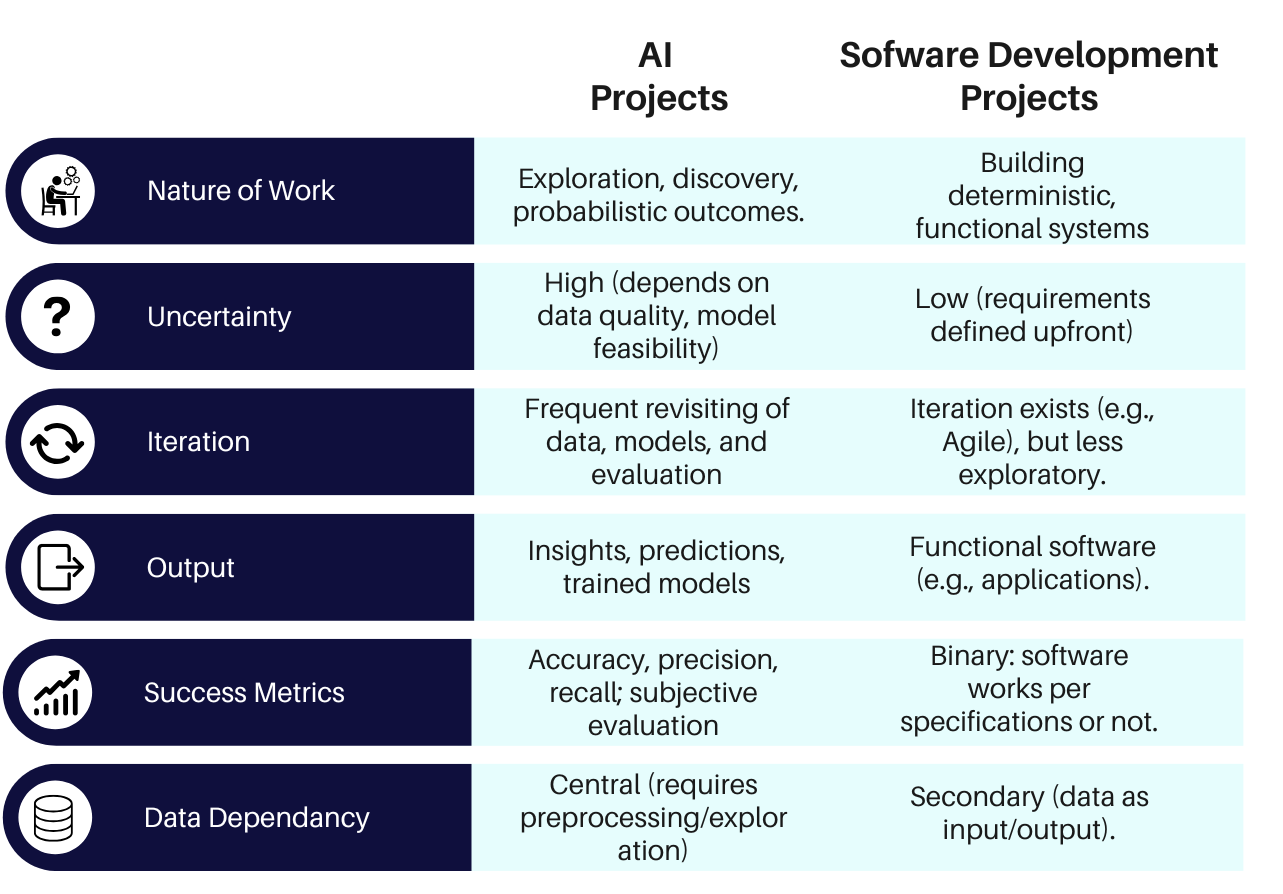
When someone asks what is the fundamental difference between ai development and regular software development, they usually mean the contrast between probabilistic learning systems and deterministic rule-based systems. That contrast drives choices in design, validation, and deployment.

Key technical differences
-
Data versus code
- AI development treats data as the primary asset. Models learn from labeled or unlabeled examples.
- Regular software treats code as the primary asset. Inputs follow explicit code-paths and validations.
-
Uncertainty and outputs
- AI systems produce probabilistic outputs and can be right or wrong with degrees of confidence.
- Regular software produces deterministic outputs given the same input and code path.
-
Development lifecycle
- AI lifecycle includes data collection, labeling, feature engineering, model training, and retraining.
- Regular software lifecycle emphasizes requirements, design, implementation, and testing.
-
Testing and verification
- AI testing focuses on dataset splits, performance metrics, and robustness across data shifts.
- Regular software testing focuses on unit tests, integration tests, and formal verification of logic.
-
Monitoring and maintenance
- AI needs data drift monitoring, model monitoring, and periodic retraining.
- Regular software needs error logging, patching, and functional updates.
Understanding what is the fundamental difference between ai development and regular software development helps teams choose the right workflows and tooling from day one.
Team skills and roles: people make the difference
- AI teams often include data scientists, ML engineers, data engineers, and domain experts.
- Regular software teams usually include backend, frontend, QA, and DevOps engineers.
AI projects demand skills in statistics, data wrangling, and model interpretation. Traditional projects demand strong system design and software engineering discipline. When you ask what is the fundamental difference between ai development and regular software development, remember that the roles and hiring needs change dramatically. Hire for data intuition for AI and for modular design for regular systems.
Tools, stacks, and infrastructure
- AI toolset
- Data lakes, labeling pipelines, model training frameworks, GPU clusters, experiment tracking.
- Regular software toolset
- IDEs, CI/CD pipelines, databases, containers, application monitoring.
AI projects lean on notebooks, experiment tracking, and model registries. Regular software leans on static type checks, build systems, and test suites. Knowing what is the fundamental difference between ai development and regular software development points you to the right infrastructure investment.

Risk, ethics, and explainability
AI systems can replicate biases in data and produce unexpected outcomes. They raise concerns about fairness, privacy, and accountability. Regular software has risks too, but they are often easier to trace to a specific code change. The question what is the fundamental difference between ai development and regular software development also implies different governance: AI needs model audits, fairness checks, and explainability tools. Plan for oversight and legal review early in AI projects.

Examples and a real project story from my work
I once led a fraud detection project and a billing platform in parallel. The billing platform had fixed rules and predictable behavior. We wrote code, added unit tests, and shipped. The fraud project used models trained on historical transactions. Early models worked well but failed when fraud patterns shifted. We learned to build retraining pipelines and data monitoring. These two projects taught me that asking what is the fundamental difference between ai development and regular software development is not academic — it changes daily operations and long-term cost.
Lessons I learned
- Start with simple baselines. A rule-based filter can be a strong baseline before building an ML model.
- Invest in data pipelines early. Poor data slowed model work more than model design did.
- Set expectations with stakeholders about uncertainty and model decay.

Practical tips for teams switching or combining approaches
- Prototype fast with simple models or rules to measure value.
- Treat datasets as product assets. Version them and test them like code.
- Build monitoring for accuracy and data drift, not just uptime.
- Use clear KPIs: precision, recall, latency, and business impact.
- Keep a rollback plan: be ready to revert to rule-based logic if models misbehave.
If you wonder what is the fundamental difference between ai development and regular software development on projects that combine both, the best practice is hybrid architecture. Use model outputs as signals that feed deterministic business logic. This gives you the benefits of both worlds.
Frequently Asked Questions of what is the fundamental difference between ai development and regular software development
What is the single biggest difference between AI and regular software?
The biggest difference is that AI systems learn from data and produce probabilistic outputs, while regular software follows explicit, deterministic code. This leads to different development and validation practices.
Do AI projects require different testing methods?
Yes. AI testing emphasizes dataset quality, validation splits, and robustness to data changes, while regular software testing focuses on unit and integration tests for code correctness.
How does maintenance differ between the two?
AI maintenance often involves retraining models, monitoring data drift, and refreshing datasets. Regular software maintenance focuses on bug fixes, feature updates, and code refactors.
Can traditional software replace AI in some cases?
Yes. For simple, well-defined rules, traditional software is often more reliable and easier to maintain. Use AI only when data-driven patterns add measurable value.
What skills should I hire for AI projects versus regular software projects?
For AI, hire data scientists, ML engineers, and data engineers with strong statistics and data skills. For regular projects, hire software engineers, QA, and DevOps with strong system design and coding skills.
Conclusion
AI development and regular software development differ mainly in how they derive behavior: learning from data versus following explicit code. That difference affects planning, teams, testing, and long-term costs. If you are exploring what is the fundamental difference between ai development and regular software development, start small, measure impact, and design monitoring from day one. Try a hybrid approach where models inform code, and keep stakeholders aware of uncertainty. If this article helped, explore further resources, subscribe for updates, or leave a comment with your project questions.
